A Framework for Human-Centered AI in Education
Drawing on a decade of teaching and research experience, this framework was built over three years of teaching, research, and practice — each component is classroom-explored, grounded in validated theory, and original in combination. Developed through a multidisciplinary lens spanning human factors, educational psychology, instructional design, and AI ethics, the framework is organized into three domains that address the foundational conditions, practical designs, and evaluative practices required for ethical, pedagogically sound AI integration in higher education.
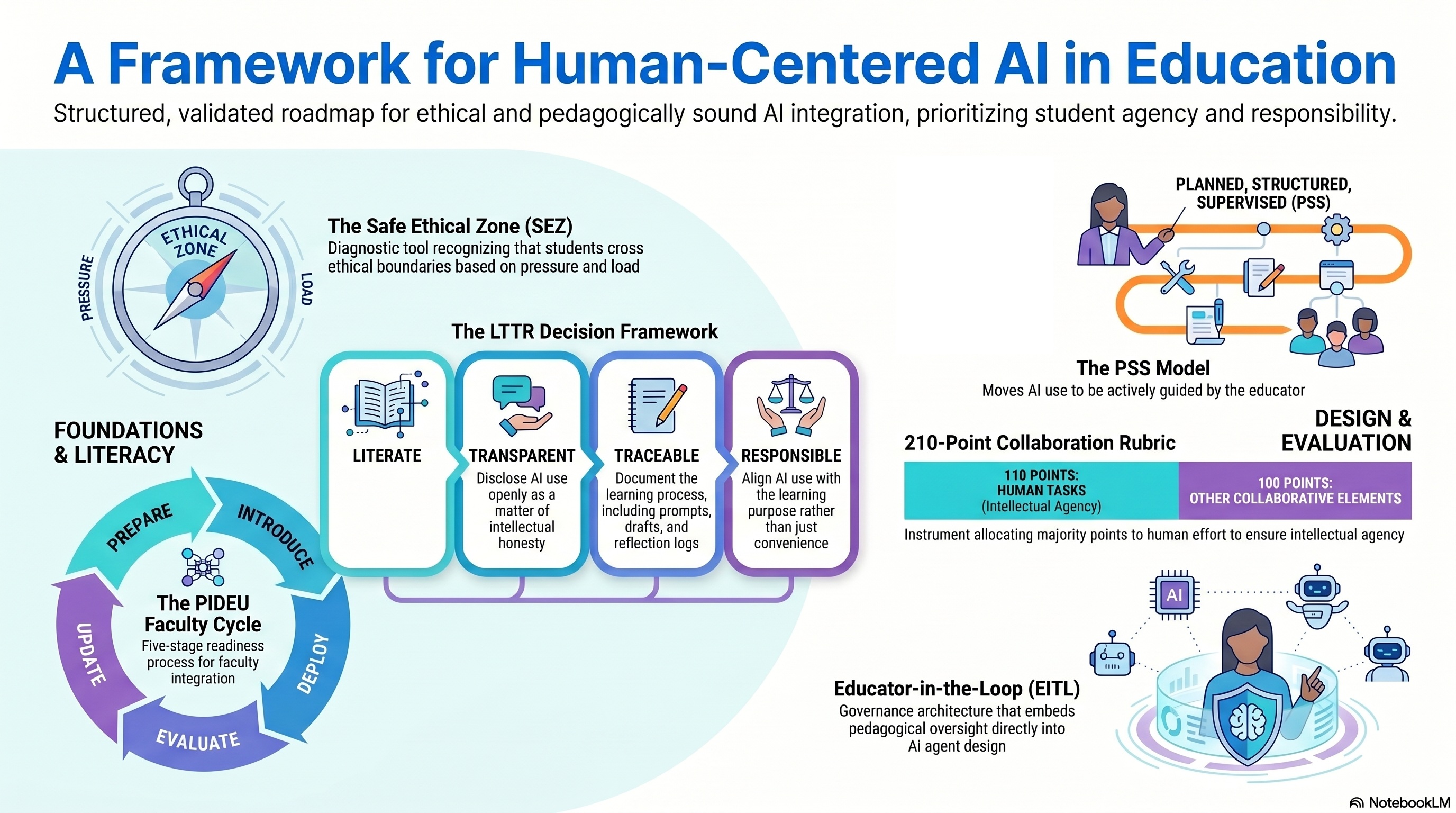
A Framework for Human-Centered AI in Education. Visual generated by NotebookLM using the framework content on this page.
Foundations
The foundational domain establishes the ethical, policy, and literacy conditions that must be in place before any AI integration can be pedagogically responsible. It addresses both the ethical environment students operate in and the baseline AI literacy all participants need.
The Safe Ethical Zone (SEZ)
A psychophysics-informed concept describing the dynamic space in which students operate ethically. Students are not consistently ethical or unethical actors — they function within a range shaped by pressure, ambiguity, cognitive load, and environmental stimuli. The SEZ describes the threshold beyond which unethical action becomes more likely.
Generative AI functions as a threshold-destabilizing force — compressing the distance between ethical intention and unethical action. The SEZ is not an excuse for misconduct. It is a diagnostic tool for designing better conditions. Students in the SEZ are often one stimulus away from crossing an ethical boundary.

The LTTR Framework
A student-facing ethical decision-making framework embedded in course design. Originally TTR (Traceable, Transparent, Responsible); Literacy was added as the foundational element — students cannot act transparently, trace their process, or exercise responsibility without first being AI-literate. The four elements are not sequential steps but interconnected conditions, each reinforcing the others.

Ethical Recovery Framework
A three-stage growth-oriented response to academic misconduct — Embrace, Process, Reconceptualize — that treats misconduct as a moment of learning rather than a verdict, completing the full cycle from curriculum design to student guidance to recovery and renewal.

Foundational Framework for GenAI Literacy & Deployment
A five-stage progression guiding learners from first access to full adoption. Cited as a core framework in the Michigan Small Business Development Center's guide on AI for Small Businesses. This baseline literacy is a prerequisite for ethical and effective AI engagement across all other domains.

Educator Responsibility & AI Literacy
Faculty AI literacy must come first — student AI literacy follows from it. This domain addresses the educator's dual responsibility: developing their own AI competencies, and translating those competencies into curriculum design, instruction, and assessment. It also defines the five concrete action areas that make ethical AI principles operational in the classroom.
The PIDEU Cycle
A practitioner-developed, iterative cycle guiding educators from foundational AI awareness to confident, pedagogically grounded integration: Prepare → Introduce → Deploy → Evaluate → Update. PIDEU repositions AI literacy not as an optional professional development topic, but as a core faculty competency.
The PSS Model — Planned, Structured, Supervised
The Planned-Structured-Supervised (PSS) model provides faculty with the tools and strategies to embed AI into curriculum design, instructional practice, and assessment. Students are not left to navigate AI independently — they engage through deliberate, educator-designed experiences. The PSS model is operationalized in the classroom through two interaction strategies described in Domain II.
Five Pillars Educator Action Framework
Five interconnected design pillars translate ethical AI principles into concrete educator responsibilities: outcomes alignment, curriculum and assessment design, trauma-informed design, clear expectations, and AI literacy education. These pillars define what it means for an educator to take responsibility for AI integration in their course.

Design & Implementation
With foundations in place, this domain addresses the practical design of AI-integrated learning — how interactions are structured, how agents are built, how AI supports instructional design, and what deployed student-facing tools look like in practice.
The PSS model is operationalized through two complementary classroom interaction strategies. In Student-Driven Interaction, students take the lead — crafting prompts, critically evaluating AI responses, and refining their questioning through an Ask–Review–Reflect–Follow-up cycle. In AI-Driven Interaction, a custom AI agent initiates guided dialogue, provides adaptive feedback, and scaffolds student responses according to predefined learning objectives. Both models are intentional, pedagogically grounded, and ethically accountable.
Published as an institutional resource at WMU's Teaching and Learning website →The Prepare–Create–Test–Improve–Integrate (PCTII) cycle is a practitioner-developed, code-free process for building custom educational AI agents. The Educator-in-the-Loop (EITL) two-layer governance architecture ensures pedagogical oversight is embedded in agent design from the start — not added as an afterthought.

AI can support educators in curriculum development, assessment creation, and content design. A framework of 14 storytelling characteristics (10 primary, 4 secondary) provides criteria for evaluating and designing high-quality AI-generated instructional content. These characteristics are implemented through the Fact-O-Fictionist GPT, which uses a structured A–L intake interface to constrain AI output within pedagogical boundaries. Additional examples of AI as an instructional aid include:
- Curriculum Development Agent — supports structured course and module design
- Trauma-Informed Design Agent — guides educators in applying trauma-informed principles to instructional content and assessments
These agents represent the operationalized output of the interaction design and agent design frameworks — what PSS and PCTII look like when fully implemented for students. Each agent is custom-built, educator-governed, and designed to scaffold thinking rather than replace it.
- Management Case Study Agent — guides students through case analysis with adaptive prompting
- Project Pal — supports project-based learning with structured checkpoints
- Fact-O-Fictionist GPT — generates instructional content constrained by pedagogical storytelling criteria
Assessing and Promoting Learning
The third domain asks: is real learning actually happening? It addresses both the measurement of human-AI collaboration quality and the conditions necessary to ensure students remain independent, critical thinkers in AI-integrated environments.
A 210-point instrument measuring the quality of human-AI interaction across nine criteria: idea and initial argument, raw content, coherent content generation, review and validation, re-prompting, content regeneration, references, reference validation, and rewriting. 110 points are assigned to human tasks; 100 to AI tasks — reflecting the framework's commitment to keeping the human as the primary intellectual agent. Classroom-tested and published.
This rubric was developed and published in 2023–2024. It represents original scholarly contribution to the field of human-AI collaboration assessment in higher education.

Specific strategies and protective design elements that prevent students from offloading their thinking to AI. Published as an institutional resource at WMU covering AI and critical thinking in education.
A structured, educator-designed prompt library developed for an online people-management course, offering students a principled middle ground between unrestricted AI use and complete restriction. Six curated prompts scaffold student thinking rather than replacing it — grounded in a proposed typology for generative AI in teaching and learning. A design case is under review for publication in the International Journal of Designs for Learning.